

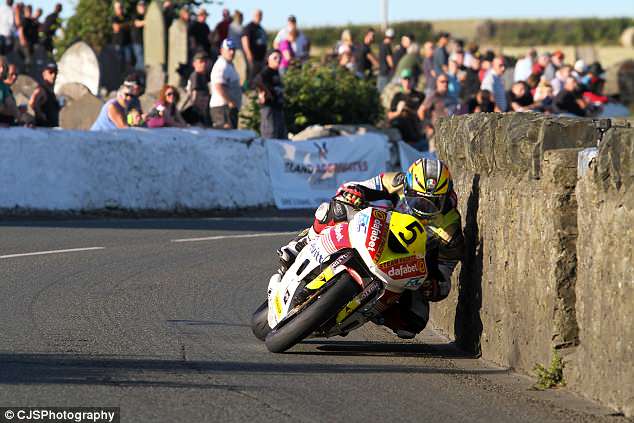
Isle of Man TT
Motorsport event of the year in one of the most beautiful island of The UK
The Tourist Trophy was valid as the Grand Prix of Great Britain from the first edition of the Motoworld Championship in 1949 and until 1976, when it was excluded from the calendar irided for the excessive danger of the circuit. From 1977 to 1990 it was included in the calendar of the Formula TT world championship, a championship created precisely to give visibility to this race following the exclusion from the motorcycle world championship.
In the years in which he was part of the motorcycle world competitions, other Italian drivers also won important victories: among them Carlo Ubbiali, Tarquinio Provini and Giacomo Agostini who, with 10 victories, is one of the most victorious drivers on the Isle of Man. Agostini himself, about the TT, said: “To win the Tourist Trophy it is necessary to make the curves slow and the fast curves strong”.[ 2]
The race also increasingly attracted the interest of the manufacturers and, for example, Honda chose the Isle of Man for the debut of its racing motorcycles in Europe.
The most victorious rider on the circuit is Joey Dunlop, a British driver who died in 2000 who managed to win 26 successes in his long career, followed by John McGuinness with 23 and multi-time world champion Mike Hailwood with 14, while the record of victories in a single edition (5 victories out of 5 games played) was recorded by Ian Hutchinson in the 2010 edition of the race.
The races have been run 101 times since the inaugural event in 1907 and moved to the Mountain Course in 1911, which has seen 266 fatalities, 155 during the June TT event.
The unforgiving nature of the TT Mountain Course, with its inherent risks, provides part of the appeal for those who choose to take part, the high speeds of up to 200mph a major element of the challenge.
The natural hazards posed by a circuit which is staged on closed public roads are obvious – walls, hedges, telegraph poles, houses, grass banks all line the 37.73 mile course which snakes through towns and villages and over the A18 Snaefell Mountain Road at speeds often averaging upwards of 130mph.
While critics regard the races as an anachronism in a modern-day world in which health and safety rules have eliminated many of the risks associated with much more genteel events, supporters will point to the fact that riders contest the event of their own free will, fully aware of the risks they are taking.
Measures such as improved road surfacing, safety audits, high marshalling standards and the placing of protective equipment around the course help to reduce the risk, but without the gravel traps and run-off areas which are an established feature of racing on purpose-built short circuits, the possibility of death or serious injury remains a clear and present danger.
Last year’s TT took a particularly heavy death toll, with five competitors dying during the fortnight and another, French sidecar passenger Olivier Lavorel, succumbing to his injuries in October.
Welsh rider Mark Purslow was killed in a practice crash and Northern Ireland’s Davy Morgan lost his life in an incident in the opening Supersport race.
Lavorel’s sidecar driver Cesar Chanal sustained fatal injuries in their crash at the Ago’s Leap section of the circuit, less than a mile from the start-line, while another sidecar pairing, father and son Roger and Bradley Stockton, died after an accident at the same area of the course later in the week.
It made 2022 the worst in the event’s history in terms of deaths, equalling the number of fatalities at the 1970 TT.
After the meeting, organisers indicated they would “learn from each incident” to remove any unnecessary risk from the event.
Greatest come back of motorsport history
Peter Hickman first win 2018
Enjoy the race
Don’t try this on the road
PROFESSIONAL DRIVER
 Discover yourself
Leave a comment